Thursday, January 31, 2008

Orchids - America's Most Popular Flowering Plant? At Least I Think So...

Every morning I have the privilege of entering a large greenhouse filled with one of the world's most amazing plants - Orchids! Just being around these plants makes me feel good. I can't help but smile when I admire there elegance and beauty.

My name is Delia Villegas and I am the "orchid picker" or the person that hand selects Orchid plants and flowers for a large Orchid mail order company. The plants I select are sent all over the country to celebrate birthdays, anniversaries and other special events. One day when I was selecting Orchid plants, I thought... what is America's most popular flowering plant? It has to be the Orchid! I set out to do some research to find out what is America's most popular flowering plant.

First of all, I must confess that I am biased (so much for journalistic guidelines). More than any other plant, I love Orchid plants and as I learn more about them, my attraction becomes even stronger. There is always something new to be learned about Orchids. For example, did you know that Orchids existed when dinosaurs roamed the earth? This discovery was made when a prehistoric bee was found in amber and when analyzed they found Orchid seeds on the bee. Pretty cool, huh? Does this mean orchids have always existed? Ok, back to my story - What is America's most popular flowering plant?

The top three potted flowering plants in terms of 2005 sales in the United States are Poinsettias, Orchids and Chrysanthemums. California accounts for 25 percent of this category's total value. Poinsettia value, which adds $242 million to this category, is down 2 percent from 2004. The value of Potted Orchids is $144 million, up 11 percent from the previous year. Go Orchids! Florist Chrysanthemum value is up 1 percent, to $68.9 million. Through my research I have discovered that sales of potted Orchids have improved over the previous years sales, year after year. That means orchids are becoming more and more popular! Woo-hoo!!

In an article in FloraCulture International titled "The world’s fascination with potted Orchids" the author writes, "The United States Department of Agriculture reports that 15.6 million pots of Orchids valued at $121 million were sold in 2003, up 18% in units from 2002. By value, California potted Orchid growers sold 40%, Florida growers sold 33% and Hawaii growers sold 14%. Orchids have become the second most popular flowering plant (after the Poinsettia (Euphorbia pulcherrima) sold in the United States. In other words, sales of potted Orchids around the world are booming."

In terms of sales, the potted Poinsettia is the most popular flowering plant with almost double the sales of potted orchids. There, I said it! But, the Poinsettia's 2005 sales are down 2% from 2004 sales yet the wholesale value of potted orchids grew by 5 percent and the number of pots sold increased by 14 percent to 17.2 million pots. If sales continue at the same rate, orchids will exceed the value of poinsettias by 2020 to become the most valued flowering plant - that's only 12 years from now! Hey, maybe if we declare orchids the official plant for Mother's Day we'll be there sooner. Heck, let's include Valentine's Day too.

Sales statistics for potted Poinsettias is down. Sales statistics for potted Orchids is up. That means Orchids are becoming more and more popular. Nevertheless, Poinsettias are popular plants otherwise we wouldn't buy them. I love Poinsettia plants too - they're beautiful! But, I have a feeling if we conducted a survey that asked, "What do you think is America's most popular flowering plant: the Poinsettia, the Orchid or the Chrysanthemum" I think the Orchid may come up on top. Why? Because we are seeing more orchids in markets and flower shops. They're everywhere. Don't worry, Orchids will never be a commodity. There are too many varieties some highly prized and rare. This adds to their mystic and umm... popularity.

Delia Villegas
OrchidGram! Newsletter Contributing Writer & Orchid Lover
www.1888orchids.com

Wednesday, January 30, 2008

Miltonia Orchid


"Miltonia orchids are native of [Colombia] South America... Miltoniopsis roezlii...
fragrant...
bloom once or twice a year, and the flowers of the miltonia orchid often remain attractive for a
month or more [or less...].

... roots must be kept evenly moist.
Too much water will cause root rot.
Too little causes the plants to dehydrate and die.

... lack of moisture. The new leaves will become crinkled.
Smooth leaves indicate the proper amount of water.
... difficult to grow in the typical home...

can best be enjoyed in Hilbert Conservatory at White River Gardens
[Indianapolis]

URL :
http://www.indystar.com/apps/pbcs.dll/article?AID=/20080126/COLUMNISTS18/801260386/-1/LOCAL17

Enjoy,
Steve
1888Orchids.com

Tuesday, January 22, 2008

Our itty bitty orchid shop on Blogger

Buy an orchid so I can retire to a sunny beach. Ehem... you can also share this application and add it to your profile. :)

Applications like this (known as ShopBots) can be found all over the internet. Now that you have come across mine, click "Share" and follow the instructions.


Sunday, January 20, 2008

Quote from Dr. Martin Luther King Jr.

"You don't have to see the whole staircase, just take the first step."

Dr. Martin Luther King Jr.

Thursday, January 17, 2008

South Florida's Winter Orchid Extravaganza - Tamiami International Orchid Festival

Miami International Orchid Festival, a major orchid event now in its
fifth year, is coming to the Sunshine Pavilion of Tamiami Fair Expo
Center(10900 Coral Way) on January 25th, 26th, and 27th 2008. The Festival has become in some aspects the largest annual orchid event of the season and
hence is billed as "South Florida's Winter Orchid Extravaganza".

Truly national and international in scope, the Miami International Festival brings
together fifty growers from the US and around the world. Orchidists from
Malaya, Taiwan, the Philippines will join growers from Brazil, Venezuela,
Equador, Singapore and Peru as well as local and national growers. Some of
these leading orchid nurseries have never before exhibited in South Florida
and will be offering the public new varieties of orchid species and hybrids
not previously available here.

The Tamiami Festival is a community based event with the sponsorship of the
not for profit Greater Miami Orchid Festivals, and with participation by
Orchid Society of Coral Gables, the South Dade Amateur Orchid Society, the
American Orchid Society's Florida Carribean Judging Center, the Coalition on
Orchid Species and Orchid Mania(the children's AIDS charity), all of whom
will be contributing to the staffing of the event and sharing in its
success. An overwhelming majority of local commercial orchid growers will
also be exhibiting and vending. The event is intended to bring the entire
orchid community of South Florida together.

Staged exhibits will be mounted by both commercial and amateur groups. The
latter will, in a unique feature, be competing for cash prizes for the best
exhibits. Both individual plants and exhibits will be eligible for ribbons,
trophies and the much coveted American Orchid Society awards. The public is
also invited to bring plants for exhibit and judging on Thursday January
24th between 12 and 5 PM.

Orchid theme arts and crafts will be offered for sale as well as a full
range of supplies, materials and tools for all the orchid grower's needs.

Lectures by internationally renowned experts as well as growing classes for
amateurs and more advanced hobbyists will be presented. Local orchid
societies will be there during the entire show to recruit new members and to
help the public with their orchid related problems.

Miami's first orchid event of the year promises in many aspects to be not
only the first but the best!

The festival is open to the public from 10:00AM- 8:00 PM Friday and Saturday
and 10-6 on Sunday. Plan to be there! Take either the 8th Street or Bird
Road exits of the Fla. Turnpike and follow the signs about a mile and a half
to the Fair Expo Center. The Festival is also easily accessed from the
Palmetto Expressway(826) at Coral Way. Proceed West to 109St.

Admission is only $7.00 and there is ample free parking convenient to the
fully air conditioned hall.

For further information or to arrange photo shoots or other extended
coverage of this colorful tropical event, contact Dr. Martin Motes at 305
2474398 or email at vandas@mindpring.com or visit

Blue orchid at 1888Orchids.com

www.miamiorchidfestival.com.

Orchids - America's Most Popular Flowering Plant? At Least We Think So


Every morning I have the privilege of entering a large greenhouse filled with one of the world's most amazing plants - orchids! Just being around these plants makes me feel good. I can't help but smile when I admire there elegance and beauty. My name is Delia Villegas and I am the "orchid picker" or the person that hand selects orchid plants and flowers for a large orchid mail order company. The plants I select are sent all over the country to celebrate birthdays, anniversaries and other special events. One day when I was selecting orchid plants, I wondered, what is America's most popular flowering plant? I thought, it has to be the orchid! I set out to do some research to find out what is America's most popular flowering plant.

First of all, I must confess that I am a biased. More than any other plant, I love orchid plants and as I learn more about them, my attraction becomes even stronger. There is always something new to be learned about orchids. For example, did you know that orchids existed when dinosaurs roamed the earth? This discovery was made when a prehistoric bee was found in amber and when analyzed they found orchid seeds on the bee. Pretty cool, huh? Ok, back to my story - What is America's most popular flowering plant?

The top three potted flowering plants in terms of sales in the US are Poinsettias, Orchids and Chrysanthemums. California accounts for 25 percent of the category's total value. Poinsettia value, which adds $242 million to this category, is down 2
percent from 2004. The value of Potted Orchids is $144 million, up 11 percent from the previous year. Florist Chrysanthemum value is up 1 percent, to $68.9 million.

In an article in FloraCulture International titled "The world’s fascination with potted orchids" the author writes, "The United States Department of Agriculture reports that 15.6 million pots of orchids valued at $121 million were sold in
2003, up 18% in units from 2002. By value, California potted orchid growers sold 40%, Florida growers sold 33% and Hawaii growers sold 14%. Orchids have become the second most popular flowering plant (after the poinsettia (Euphorbia pulcherrima) sold in the United States. In other words, sales of potted orchids around the world are booming."

In terms of sales, the potted Poinsettia is the most popular flowering plant with almost double the sales of potted orchids. There, I said it! But, the Poinsettias 2005 sales are down 2% from 2004 sales yet the wholesale value of potted orchids grew by 5 percent and the number of pots sold increased by 14 percent to 17.2 million pots. If sales continue at the same rate, orchids will exceed the value of poinsettias by 2020 to become the most valued flowering plant - that's only 12 years from now! Hey, maybe if we declare orchids the official plant for Mother's Day we'll be there sooner.

Delia Villegas
OrchidGram! Newsletter Contributing Writer & Orchid Lover


The top three potted flowering plants in the US are poinsettias, orchids and chrysanthemums.


poinsettia U.S. Total: $242,305,000
orchid U.S. Total: $143,968,000
crysanthenum U.S. Total: $68,944,000

2005
2004


With the poinsettia being the most popular. I'll discuss the attributes of each plant and then you decide which you consider most popular.

Wednesday, January 16, 2008

Rare orchid found in South Island

"rare endangered North Island native orchid has been rediscovered in the South Island.

... Georgina Upson, of Nelson, found the 10cm orchid while searchingscrubland at the base of Farewell Spit.

... Upson presented photographic evidence of her find of Pterostylispuberula... She... recognised the plant as one only found in the far north of the North
Island and near Thames... She was looking for another orchid when she stumbled across a colony of 120 plants, which were last seen south of Motueka 20 years ago.

Before her discovery only 200 of the plants were known to exist in the North Island...

the tiny plant lived in poor soil amid manuka and gorse scrub... up there -- it's windy and cold and exposed, an unpleasant place, and will
take quite a lot of work to relocate it...

unusual to find a plant so far outside its known range"

FULL STORY URL : http://www.stuff.co.nz/thepress/4357481a19754.html

Tuesday, January 15, 2008

The Orchid Conservatory at Daniel Stowe Botanical Garden

"Art at the Garden 2008, presented by Daniel Stowe Botanical Garden... in honor of the opening of the garden's Orchid Conservatory.

The art celebration will continue through March 18 and include paintings on silk, photographs and watercolors.

Featured artists include Silk Synergy artists Janet Haefner, Julianne Jennings, Karen Sistek and Merridee Joan Smith. Silk Synergy is a group of
four artists who work individually and as a group specializing in paintings
on silk.

... Greg Allikas will display a variety of his... photographs. His work appears regularly in "Orchids" magazine and in several books,
including three he co-authored with Ned Nash.

Rose Ganucheau has been painting orchids in watercolor for 20 years...

The Orchid Conservatory at Daniel Stowe Botanical Garden is scheduled to open at noon Jan. 19.
...
The conservatory will... serve as a learning environment introducing visitors to... biology of orchids."

URL: http://www.charlotteobserver.com/breaking_news/story/440631.html

Enjoy,
Steve Peralta

Sunday, January 13, 2008

11th World Orchid Conference - Miami, Florida January 23-27

"Robert Fuchs...
In 1984, the third generation orchidist won the Grand Champion award at the 11th World Orchid Conference in Miami with his Vanda Deva 'Robert.'
... Fuchs, president of R.F. Orchids in Homestead and one of the... vandal breeders in the United States.

Fuchs is now president of the 19th World Orchid Conference set for Jan. 23-27 at the Exhibition Center of the Sheraton Miami Mart Hotel &
Convention Center in Miami... Sponsors are the Fort Lauderdale Orchid Society and the South Florida Orchid Society.
... there will be more than 100 displays from the world's leading orchid houses. More than 50 countries will be represented...

the Quilt Guild of America and the Cake Decorators of South Florida (smile...) will sponsor competitions and demonstrations.

The United States Postal Service is offering five orchid design cancellations for collectors.

Conference organizers estimate the show will attract 200,000 attendees.

Gordon Dillon, former executive secretary of the American Orchid Society, is credited with the idea of creating an international, weeklong event that
would attract the best amateurs, professionals and botanists in the orchid world. His idea grew into the first World Orchid Conference that was held
in October 1954 in St. Louis. Since then, the conferences have been held in locations as varied as Honolulu, London, Singapore, Sydney, Medellin,
Frankfurt, Bangkok, Durban, Miami, Tokyo, Auckland, Glasgow, Rio de Janeiro, Vancouver, Shah Alam, Dijon and Long Beach, Calif."

URL:
http://www.sun-sentinel.com/features/home/sfl-flhg12orchidsbjan12,0,610868.story

Enjoy,
Steve Peralta
www.1888orchids.com

Friday, January 11, 2008

Orchid Discovery of the Century

Almost every orchid grower dreams of seeing the rarest of orchids, the Holy Grail, just once in their lifetime. Alexandria resident Ken Meier is one such lucky grower.

A fiber optic technician by profession, he has been growing orchids for more than two decades. His backyard greenhouse is crammed with orchids that spill out into his yard during the warm summer months. Ken, who has more than two thousand orchids in his collection, is constantly in pursuit of new and unusual orchids.

While others kick back and head for the beach during their summer vacation, Ken can be found deep in the jungles of Asia and South America looking for orchids growing wild in their native habitat.

Meier has the distinction of being one of the few westerners to have seen what has been called the “orchid discovery of the century,” growing wild in its native habitat; an orchid so spectacular, that many wonder how it could have gone undiscovered for so long.

The tale of its discovery is one filled with the drama and passion that only orchids can inspire. This orchid was brought into the United States and described as a new species by Marie Selby Botanical Gardens in 2002. It was named Phragmipedium kovachii in honor of its American discoverer, Michael Kovach, of Goldvein, Va. Eventually, its “discoverer” would be indicted for smuggling the plant into the United States, the prestigious Selby Gardens disgraced, and the original habitats of this orchid plundered by illegal collectors.

Recently, Meier led an orchid expedition to the Andes in the remote northern region of Peru. His guide knew of two habitats were the fabled phragmipedium could still be found. “We hiked for about five hours through the jungle to reach the first habitat,” recalls Ken. “It was tough going and only a few members of our group made it—the rest turned back.”

Disappointingly, while they found several of the rare orchid plants, none were in flower. While the rest of his team gave up, Meier pressed on with his guide. “It was a strenuous hike up almost vertical cliffs, shrouded in mist. We finally reached the second habitat, and there on a mossy outcrop, I saw a single flower that simply took my breath away, though I was already out of breath from the low oxygen levels at that altitude.”

Meier is as excited today, as he describes the orchid that he saw a year ago: a voluptuous fuchsia flower almost half a foot across. “The color was so rich and deep, the flower could have been made out of velvet,” he enthuses. After about half an hour of admiring the flower and taking photos it was time to leave and carefully climb back down the slippery treacherous cliffs before darkness fell.

When asked, Meiei said he had no seeds or plants of Phragmipedim kovachii from his trip. It’s illegal to remove any slipper orchid plants or seeds from their native habitat, especially so endangered a species. Soon, legally propagated plants from Peru will be exported and available in United States,” Meier said.

Even so, it will be several more years before they bloom. Meier smiles with the patience that only orchid growers know. “It’s worth the wait…and until then I have my photographs and memories from Peru to remind me why.”

Enjoy,
Steve Peralta
1888Orchids.com

Thursday, January 10, 2008

Red Orchids

Red orchids will bring a big smile to even the orchid collector! Since Valentine's Day is right around the corner, I would like you to preview our collection of red orchids for Valentine's Day 2008.
Preview them here: http://www.1888orchids.com/red_orchids_s/146.htm

Sincerely,
Steve Peralta
www.1888Orchids.com

Tuesday, January 08, 2008

Orchid Craze

THE ORCHID CRAZE AT ITS HEIGHT IN FASHIONABLE NEW YORK; Unknown a Generation Ago, the Beau Brummel of Blossoms Reigns Supreme The Danger and Romance of Orchid-Hunting Millionaires Among those who Raise it for the Market

Here's the link again: http://query.nytimes.com/gst/abstract.html?res=9A05E2DF123EE033A25754C1A9649C946697D6CF

Enjoy,
Steve Peralta
1888Orchids.com

Tuesday, January 01, 2008

Nun's Orchid

"The nun?s orchid, Phaius tankervilliae...
easily grown...

... its common name... had to do with the fact that is[t]... was frequently found growing in convents.
... the origin of the plant?s name seems to be that its striking, tubular flowers and wing-like sepals resemble the head coverings worn by nuns long ago.

... low-maintenance plant that is a vigorous grower... multiple 4-foot tall flower spikes each bearing 10 to 20 fragrant flowers up to 5 inches across.

... sepals are white on the outside with red to dark burgundy interiors edged in pale yellow. The flower?s lip is a purple tube with a ruffled tip
and short spur. Each individual blossom can last up to one month.

... large, thin, pleated leaves that reach up to 3 feet...

brought into cultivation from China in the 1800s...
a terrestrial orchid...

prefers temperatures of 65 to 75 degrees during the day and 55 to 60 degrees at night...
a bright window located away from hot or cold drafts and soil that is kept quite moist but not soggy.

... can be taken outdoors to spend the summer in a moist, shady spot. It is very adaptable and will adjust to... summer temperatures when given plenty
of water and good drainage.

... heavy feeders... should be fertilized wee[a]kly with every watering during the growing season...
quite cold tolerant... can withstand temperatures to 40 degrees...

Repot every two or three years right after plants finish blooming. Frequent repotting keeps plants producing strong new growth. Use a large, deep sturdy pot that will allow plenty of room for the roots while giving
counterbalance to the large upper part of the plant. Use a good quality potting soil that holds moisture while providing good drainage.

... easy to propagate...
dividing the plants at the end of the growing season. Place at least three stems in each pot and keep the new divisions shady and moist while rooting.

... growing outdoors in northwest Florida and in Dothan."

URL :
http://www.tuscaloosanews.com/article/20071231/NEWS/326931503/1005/SPORTS0106

Monday, December 31, 2007

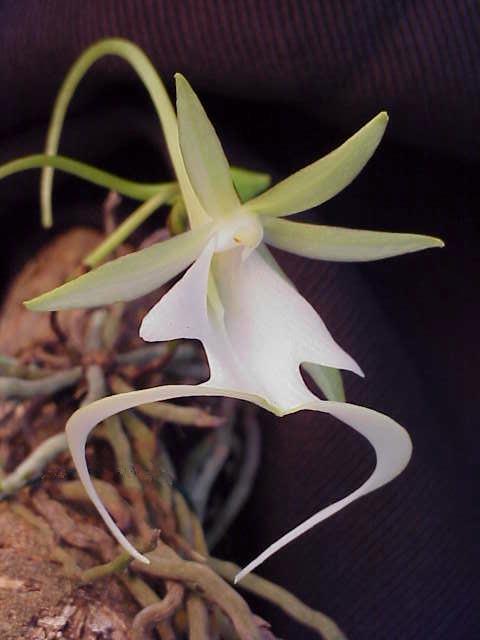
Polyrrhiza lindenii [Dendrophylax lindenii (Lindl.) Benth. ex Rolfe] The Ghost Orchid


Polyrrhiza lindenii [Dendrophylax lindenii (Lindl.) Benth. ex Rolfe]...

Native to Southwest Florida and Cuba.
In Florida, the range is localized in swamps in the Fakahatchee, Big Cypress and Corkscrew areas...

Found on trees, including pop ash, pond apple, bald cypress, maple, and oak in hardwood hammocks, sloughs and cypress domes.

... Blooms appear May through August, although occasionally in other months; heaviest blooming is in July. Typically the plant has one or two blooms, but there can be as many as 10. Individual blooms last 10 to 14 days.

... Pollination is done by the giant sphinx moth.

.., The ghost orchid got its name because the plant has no leaves ? only roots ? and when it blooms, the flower seems to float in mid-air.
...
The highest known location of any ghost orchid in Collier County was in Fakahatchee Strand State Preserve, the orchid capital of North America, at
23 feet; the Corkscrew orchid was 45 to 50 feet above the ground.
... the Corkscrew orchid bloomed three times between July 7 and Oct. 15.
... Usually, one or two blooms appear; the Corkscrew orchid had 12 flowers
the first time it bloomed, 10 the second and three the third."

URL :
http://www.news-press.com/apps/pbcs.dll/article?AID=/20071229/LIFESTYLES/71228073/1075

photo : [caption : A... ghost orchid... on a bald cypress tree at Corkscrew
Swamp Sanctuary...
Sanctuary officials believe the flower is between 20-30 years old...]

"the Fakahatchee Strand...
a wild orchid clinging to a branch.
... said state park guide John Elting. "That's a clamshell orchid blooming..."

rare ghost orchids and ribbon orchids.
...
Wild orchids draw some of the visitors to the Fakahatchee Strand...

The Fakahatchee Strand lies west of the Big Cypress National Preserve and Everglades National Park. A strand is a narrow slough, pronounced "sloo," where trees grow along a natural depression. Park rangers joke that the Fakahatchee is "the Grand Canyon of the Everglades," even though it's only a few feet deeper than the areas surrounding it.

Beginning in World War II, the giant cypress of the Fakahatchee were logged for shipbuilding and construction. Millions of feet of timber were cut in
the 1940s and '50s. Small railroad tracks carried logs out of the swamp. The ridges that supported those tracks still line the strand.
...
The 90,000-acre swamp gained fame in "The Orchid Thief," a 1998 book by Susan Orlean. Her story of an... orchid poacher became a... 2003 movie
under the name "Adaptation." Orlean described the Fakahatchee as "beautiful the way a Persian carpet is beautiful: thick, intricate, lush, almost
monotonous in its richness."

Elting loved the vivid storytelling and painstaking research of "The Orchid Thief," but said Orlean didn't care for being in the swamp. She didn't take
the wading tour."

URL :
http://www2.tbo.com/content/2007/dec/27/me-swamp-tour-a-slip-back-in-time/

http://cmsimg.news-press.com/apps/pbcsi.dll/bilde?Site=A4&Date=20071229&Category=LIFESTYLES&ArtNo=71228073&Ref=AR&Profile=1075&MaxW=290

Sincerely,
Steve Peralta
http://www.1888orchids.com/


"the Fakahatchee Strand Preserve State Park in southwest Florida.
... has been the scene of numerous orchid thefts...

park biologist Mike Owen...
lead[s]... group of orchid enthusiasts... during a four-hour swamp walk.

more species of orchids... grow wild here than anywhere else in the country...

There are 315 ghost orchids scattered across the Fakahatchee's 85,000 acres, according to Owen... They don't bloom until summer...

The park offers these Saturday tours during Florida's November to April dry season, when the orchids are easier to find.

The park lies about 70 miles west of Miami, across the Miccosukee Indian Reservation and a five-mile stretch of road...
The Fakahatchee is part of the Everglades ecosystem that streams down from Lake Okeechobee to the Florida Keys. It's the largest strand swamp in the world [really ?]: a 19-mile long channel cut 2- to 3-feet deep into a limestone bed over more than 5,000 years. Low streams called sloughs flow throughout the strand...

[Owen's ] notes document the locations and conditions of endangered plants; some... are growing where previous orchids were stolen... come across a ghost orchid, it will get a detailed entry - how many roots it has, how high off the ground it is and other remarks on its health.
...
our first orchid... flat green roots of a ribbon orchid...
a blooming orchid that Owen calls the "roller coaster orchid." "flowered star orchid," he says...

Owen temporarily stopped taking tours into this particular slough after several orchids went missing.
He's overjoyed to find tiny helmet and night-scented orchids growing in a blank patch in the moss on a tree - the scar of an orchid theft.

Their remote habitat and fear of the unknown protect the orchids that remain from all but the most determined thieves, Owen says.
...
After more than three hours in the water, we've seen 10 different orchid species on this walk - but not the ghost orchid....

Owen's hands suddenly go up in victory. A thin green ribbon with white dash lines appears to be tied around the rough bark of a pond apple tree. It's a young ghost orchid.
...
Orchid nurseries famous in the state... can't grow these delicate plants...
Ghost orchids restrict themselves to very specific growing conditions, pollinated by just one species of moth...

Owen is encouraged to find three active growing tips... and deems the plant generally healthy. He's been watching it since 2003, and guesses it could
be another decade before it blooms.
...
The park is about a two-hour drive west of Miami and is located just west of Copeland...
Swamp walks last about four hours."

URL : http://www.miamiherald.com/775/story/430075.html


A Rare Blooming Ghost Orchid found in Florida's Audubon Corkscrew Swamp

A rare ghost orchid discovered last year in Florida's Audubon Corkscrew Swamp Sanctuary began blooming this week, and Naples-area hotels are making the most of the event with special promotions.
The elusive plant was the subject of the best seller The Orchid Thief and its movie spinoff, Adaptation, which charted the sometimes-bizarre world of orchid enthusiasts. There are believed to be about 1,000 ghost orchids in southwest Florida, but few are easily accessible, and their whereabouts are kept under wraps to protect them from poachers.
But the Corkscrew Swamp specimen is within 100 feet of a visitor boardwalk and visible with a spotting scope. Even better, the plant produced 12 flowers in a single blooming last year — unprecedented, says executive director Ed Carlson. Blooms typically last three weeks, but last year this plant blossomed three times into September. Tourism types are keeping their fingers crossed.

http://www.usatoday.com/travel/destinations/2008-06-26-florida-ghost-orchid_N.htm?csp=34
Enjoy,
Steve
1888Orchids

Thursday, December 27, 2007

Taiwan Orchid Plantation, an orchid biotech park located in Tainan

"The National University of Kaohsiung (NUK) forged cooperative ties... with
the Taiwan Orchid Plantation, an orchid biotech park located in Tainan
County, southern Taiwan... to breed high-quality orchid seedlings and boost
the competitiveness of Taiwanese orchids on the international market.

... a greenhouse will be built for the use of academia-industry cooperative
research projects.
The NUK will also install a laboratory in the park to engage in virus tests
on orchids in a drive to breed healthy and high quality seedlings...

The cooperation is part of the government's national high-tech development
program in agricultural biotechnology being carried out by NUK, National
Tsinghua University, National Cheng Kung University, National Pingtung
University of Science and Technology and the Taichung-based National Museum
of Natural Science.

The plantation, located in Hobi township and inaugurated at the end of
2004, covered 23 hectares in the first stage of its five-stage construction
plan, and is now at the third stage. When all five stages of the plan are
completed, the total area of the plantation will cover some 170 hectares.

The Tainan county government welcomes orchid breeders, growers and traders,
as well as international marketing companies of floral products and related
businesses, to set up offices in the plantation."

URL : http://www.chinapost.com.tw/business/2007/12/18/135339/Orchid-biotech.htm

Orchid Blog
http://www.1888orchids.com/Orchid_Blog_s/34.htm

The Virgin Mary Orchid - Caularthron bicornutum


"the Virgin orchid or the Virgin Mary orchid... Caularthron bicornutum.
... one of almost 200 species of native orchids found in the country... flowers... mainly white.

... there are two virgin orchids, the common one and another smaller species sometimes referred to the Little Virgin orchid. This is not as common as the other and tends to be found patchily on trees distributed inland, even in parts of Port of Spain. The common Virgin Orchid is a species that is found in both Trinidad and Tobago and the species is well known from the Guianas, Venezuela and Colombia.

In both islands its distribution is mainly coastal although the species may be seen in forested areas inland. It is particularly common on the Bocas
islands, Gasparee and Little Centipede, and along much of the north and northeast coasts of Trinidad and the windward coast of Tobago...

It is highly tolerant of windy sea blast conditions and seems equally at home as an epiphytic or terrestrial species... it does not grow in soil or litter but rather on bare rock. Most people will not notice them except when in bloom and only if they happen to be looking up into the branches of trees or on exposed rock faces of cliffs. They are particularly common on the trunks of coconut trees and balata
trees and old plants may consist of dozens of pseudobulbs...

it is not the white sepals and petals that give the name virgin to the species, but that unique orchid structure that is formed of the fusion of the reproductive parts of the flower-the column. This stands projecting from the apex and it takes no imagination to see the characteristic Madonna
figure, as you may see in many a statue in catholic churches and religious art, a tall shrouded figure with the shroud extending over the shoulders.

The flowers are immaculate white, forming a five-pointed star. The lip is white, three-lobed with two raised yellow ridges close to the column and is
freckled with crimson spots or streaks. The flowers appear serially over several weeks on flower stalks that may measure up to about 60 centimetres
in length, and when in peak the stalk may have a dozen or so open flowers. A single plant flowering in its early years may consist of a few
pseudobulbs the year's annual growth producing three of four flower stalks.

... an old plant girdling a balata tree, consisting of perhaps 30 or 40 pseudobulbs each bearing a flower stalk-tipped with a dozen or so of these striking flowers, can be nothing but stunning... my guess is that they only grow to such proportions because there are far too high up for the collectors.

... Depending on the age of the plant more than one new shoots appear from the bases of the old pseudobulbs. But if you examine the bases of the old pseudbulbs you will see a uniform slit in each and if you tap it, it will sound hollow. It is. If you continue tapping it you might see a few
moderately sized ants appear. They live there. And if you continue observing the same plant in late November or early December you will see
that the shoot has become swollen into the characteristic pseudobulb and at the apex you will see the emergence of the new flower stalk and-one or two ants sitting on the emergent stalk. Possibly you might see also a tiny droplet secreted from the flower stalk and even see one ant grasp the tiny sphere in its fierce jaws.

What is the ant doing? Simply collecting a reward for its presence on the growing and tender stalk, warding off any other insects that might fancy
some tasty plant juices. Look at every flower stalk and you will see exactly the same right through the flowering season that runs through to April before a brief rest and a repeat of the cycle with the first rains, every year."

URL : http://www.trinidadexpress.com/index.pl/article_opinion?id=161254936

Wednesday, December 26, 2007

Orchid Photo Gallery Grand Opening...

"images of orchids...
Howard Gordon...
South Florida...

grand opening of his Orchid Photo Gallery...

He's looking forward to the World Orchid Conference in Miami, where he will
have a display table"

URL :

http://www.sun-sentinel.com/features/arts/sfl-enartrdpsbdec19,0,1358200.story?coll=sofla_features_food_xpromo

Monday, December 24, 2007

Merry Christmas

We will be back to blogging after the holiday... Merry Christmas and a prosperous New Year from the 1888Orchids.com family!

Steve Peralta
Yenny Badillo
Andrea Molina
Delia Villegas
Rene Hernandez
Jimmy San Paolo

Happy Holidays!!

Thursday, December 13, 2007

Psychopsis papilio - Oncidium Papilio (Psychopsis)


"Psychopsis papilio
... Found... from Trinidad to Venezuela, Colombia and Peru and Bolivia...
flowers... appearing one at a time but intermittently over a long period, often many months...

Light: Morning sun and then shade. Culture: A key to successfully growing this... orchid is excellent drainage and bright light. Aliflor... the expanded clay orchid mix... grow them in clay pots so that the roots can dry readily.

... in the northeast corner of the shadehouse, exposed to full morning sun. The walls of the shadehouse are chainlink, and air flows freely... watered twice a week, drying thoroughly between.

... fertilize weekly in the growing season... the end of April to November. In winter... reduce the frequency of water and fertilizer applications.

Papilios don't like repotting and do well when they are crowded. Only when the pseudobulbs and roots begin to creep over the edge of the pot should
you consider repotting.

The... firm Carter and Holmes Orchids advises removing the plant from its pot, soaking the plant in Superthrive or another root growth stimulant for
a few hours and then allowing it to dry for a couple of weeks before repotting.

... During this period, the plants should be misted on clear, sunny mornings, but not watered otherwise...
This treatment helps initiate new roots.
Water lightly after repotting because the plant is susceptible to fungus and bacteria at this stage, and dryness inhibits disease."

URL : http://www.miamiherald.com/living/home/gardening/story/334633.html

photo :
http://media.miamiherald.com/smedia/2007/12/07/11/181-watch.embedded.prod_affiliate.56.jpg

Enjoy,
Steve Peralta
1888Orchids.com

Naples Orchid Society - Cool Site

http://naplesorchidsociety.org/

Enjoy,
Steve
1888Orchids.com